Impact and effort matrix
The impact and effort matrix.
Imagine you have one developer for the quarter and a list of improvements that includes appointment reminders, online booking and a new customer portal. The ideas may all sound worthwhile until you ask how much each one would help and how long it would take. The impact and effort matrix puts both answers on a chart so you can compare them.
Impact is the difference an idea would make to the outcome you care about. For the team in this example, that means fewer missed appointments or more customers coming back. Effort is what it would take to do the work. The team looks at developer time and gives each idea an effort score from 0 to 10. You could base your score on cost or staff time if either is a better measure for your decision.
The four boxes
What the four boxes mean.
The higher an idea sits on the chart, the more impact you expect. The further right it sits, the more work you expect it to take. Each of the four boxes, sometimes called quadrants, gives you a different starting point for the decision.
High impact, low effort
Quick wins. Start here if you're confident the benefit is real. A reminder before each appointment could prevent missed bookings without taking much development time.
High impact, high effort
Bigger projects. Pick the projects worth making room for. Online booking could help a lot of customers, but someone needs to plan the work and agree what can wait while the team builds it.
Low impact, low effort
Small improvements. Save these for a quieter week or do them alongside related work. Redesigning the logo might be easy in this example, but it would do little to reduce missed appointments.
Low impact, high effort
Defer or rethink. Set these aside if the work outweighs the likely benefit. Moving to a new system for managing customer records could take weeks, so the team would need a clear reason to do it now.
You may also see these boxes called quick wins, big bets, fill-ins and money pits. In this example, scores of 5 or more count as high on either scale. If an idea is close to a dividing line, look at the scores and discuss it before you decide what to do.
Step by step
How to score your ideas.
Allow around 35 minutes for scoring and discussion if you have about ten ideas. Collect the list before the meeting if you can.
- Agree what you're trying to improve
Write it somewhere everyone can see. If some people score an idea for reducing missed bookings and others score it for saving staff time, ask the group which outcome matters for this decision.
- Agree what counts as effort
Decide what goes into the estimate, such as testing and training as well as the time to build it. Say what a low score and a high score would look like.
- Ask everyone to score independently
Give each idea a score from 0 to 10 for impact and another for effort. Make sure the people doing the work have a chance to give their estimate.
- Compare the results
In an online room, each idea appears at its average position. Select an idea to see how far apart the votes were, especially when a low average hides some very high scores.
- Decide what you'll take on
Start with the work that would help and fits the time you have. For a bigger project you choose, agree who's responsible and what they'll do first.
A worked example
Eight ideas and one developer.
In this example, the team wants fewer missed appointments and more customers coming back. It scores expected impact and development effort from 0 to 10. These scores show how the method works.
| No. | Idea | Impact | Effort | Box |
|---|---|---|---|---|
| 1 | Send a reminder before each appointment | 8 | 2 | High impact, low effort |
| 2 | Make the invoice easier to read | 6 | 2 | High impact, low effort |
| 3 | Add online booking | 9 | 7 | High impact, high effort |
| 4 | Rebuild the customer portal | 7 | 9 | High impact, high effort |
| 5 | Automate the weekly sales report | 3 | 2 | Low impact, low effort |
| 6 | Redesign the logo | 2 | 3 | Low impact, low effort |
| 7 | Move to a new system for managing customer records | 4 | 8 | Low impact, high effort |
| 8 | Translate the website | 2 | 7 | Low impact, high effort |
What the team did
The team starts with reminders and the invoice fix, which can both fit into the same week. There is time for one larger project, so the team compares online booking with the portal rebuild and chooses booking.
The sales report can wait until there's time. The move to a new system goes back on the list if the current one starts causing problems.
With a team
Ask what people included in their scores.
Someone may rate online booking as a quick job because they're picturing a form on the website. A colleague may rate it as weeks of work because they're thinking about cancellations and keeping the booking calendar up to date. Ask what each person counted. You might discover you were discussing two different versions of the same idea.
Give people time to score again if the discussion changes what they think. If the ratings are still far apart, write down what you need to find out before committing.
Choose “Impact and effort” when you set up the room, then ask everyone to score the ideas on their phone or computer.
The chart shows each idea's average scores. Select an idea to see how far apart people's ratings are.Compared
When should you use Eisenhower instead?
Use impact and effort when you're deciding which projects or improvements are worth the work. Use the Eisenhower matrix when you need to decide what needs attention now and what can go in the diary. You might use impact and effort to choose online booking, then use Eisenhower to sort the tasks leading up to its launch.
Impact and effort matrix
High impact, low effortHigh impact, high effortLow impact, low effortLow impact, high effortHigher means more impact. Further right means more effort.Compare how much each project could help with the time and resources it would take.
Eisenhower matrix
Important up, urgent acrossDecide which tasks need doing now and which deserve time in the diary.
The Eisenhower matrix explained →Three more matrices
Reward up, risk acrossSee how the other charts help with uncertainty, deciding who to involve and choosing which work to hand over.
Compare all five →
Free download
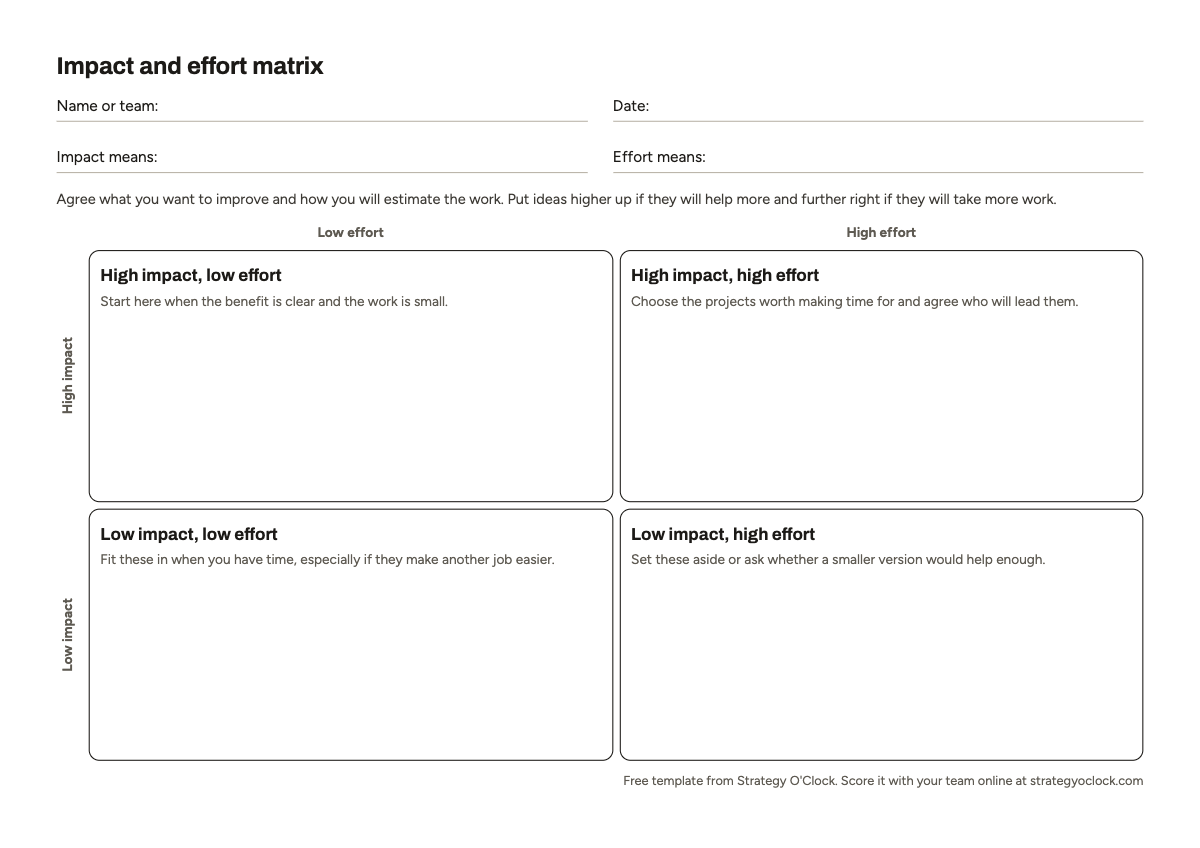
Download the impact and effort template.
The free A4 sheet has all four boxes and space to write what impact and effort mean for your decision. Download it directly, or open a room if you'd like everyone to score the same list from their phones.
Questions people ask.
What is an impact and effort matrix?
It's a chart that compares how much each idea might help with how much work it would take. You may also hear it called an action priority matrix or a value versus effort matrix.
What are the four boxes?
High impact and low effort, high impact and high effort, low impact and low effort, and low impact and high effort. On the chart, higher means more impact and further right means more effort.
Is this different from the Eisenhower matrix?
Yes. Eisenhower asks how soon something needs doing and how much it matters. Impact and effort asks how much it could help and what it would take.
Who should score the effort?
Start with the people who would do the work. Compare their estimates with the rest of the team's and ask what each person included, especially when the estimates are far apart.
Can I print a blank copy?
Yes. Use the free A4 template above, or open a team room with impact and effort selected.
Score your ideas with the team.
Ask everyone to score the list on their phone or computer, then discuss the ideas people rated differently before you choose what to do.